

Description: Twines
Technical characteristics of polypropylene twine
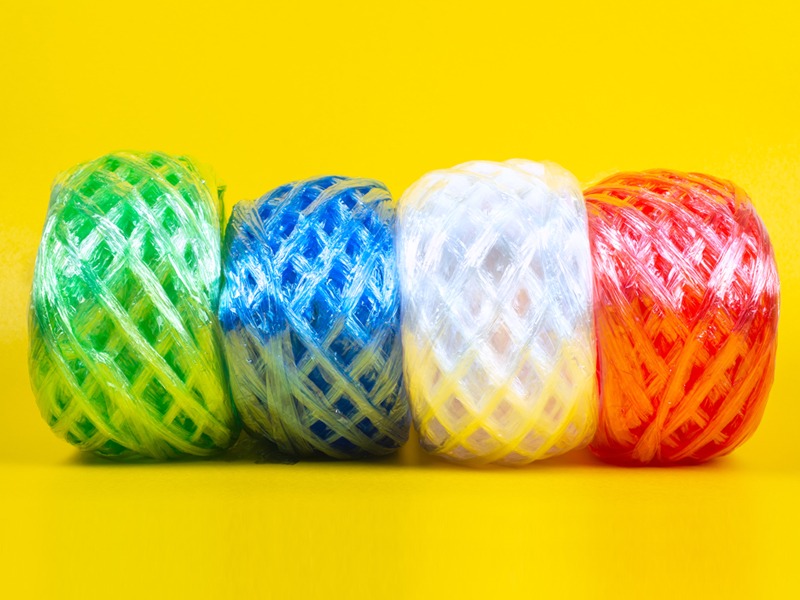
In its appearance, polypropylene twine resembles a thin rope formed by twisting several fibers. Polypropylene twine is lighter and thinner than a jute thread with the same strength.
The properties that allowed synthetic twine to displace natural fiber twine are:
- Non-hygroscopicity, that is, almost zero absorption moisture from the environment.
- Elongation under ultimate load (18-20%)
- Melting point 150 to 170 ℃ (depending on the type and model of twine)
- Buoyancy (relative specific gravity of polypropylene twine varies from 0.70 to 0.91 kg/m3)
- Low electrical conductivity
- Resistant to to alkalis, acids and solvents, to rotting, to the destructive influence of bacteria, parasites, to mechanical stress (scratches), as well as to repeated bending
- Resistance of the color coating (if any)
Twine can be stored without compromising its technical properties even outdoors or in rooms unsuitable for storage: in freezers (refrigerators), in greenhouses, in cellars. A long stay in water also does not affect its characteristics, since the twine, as mentioned above, has the properties not to absorb moisture.
Also, one of the advantages of this packaging material is that the length of the winding has almost no effect on the weight of the reel, therefore, even with a large footage, the latter are quite light.
Polypropylene twine is one of the relatively safe packaging materials, practically harmless to human health. This type of twine is used even in the food industry, for example, when tying cakes.
One of the disadvantages of this packaging material is its instability to UV radiation and temperatures above 160 ℃. Under the influence of the above factors, polypropylene, of which the twine is made, begins to decompose, releasing a number of harmful substances, including formaldehyde.
A conditional disadvantage of polypropylene twine is that the material is not environmentally friendly. Under natural conditions, polypropylene twine decomposes from 180 to 200 years.
Fields of application
The characteristics of polypropylene twine allowed it to be used in various fields: from agriculture to construction. The product is actively used by a wide range of consumers: manufacturers of goods, private consumers, as well as logistics companies.
Key industries for the active use of polypropylene twine:
- Agro-industrial complex (packing of hay bales and straw, tying plants in greenhouses). For agricultural producers, by the way, there is a special subspecies of polypropylene twine - hay knitting (twisted).
- Food market (food packaging).
- Chemical industry (packaging of mineral fertilizers and chemicals).
- li>
- Production and packaging of furniture.
- Logistics companies, post office (manufacturers have launched special products for packing parcels and parcels), warehouses.
- Consumer sector (for personal needs, for example , relocations).
- Construction, repair, restoration.
Types of twine
Currently, products are mainly produced in two types : household purpose and technical. For household needs, twine is produced with a diameter of 1 mm to 4.8 mm. The diameter of technical twine is from 2.3 mm to 2.8 mm. Twine also differs in nominal linear density (tex): the greater the linear density, the greater the thickness of the twine. The density varies from 800 to 5000 tex.
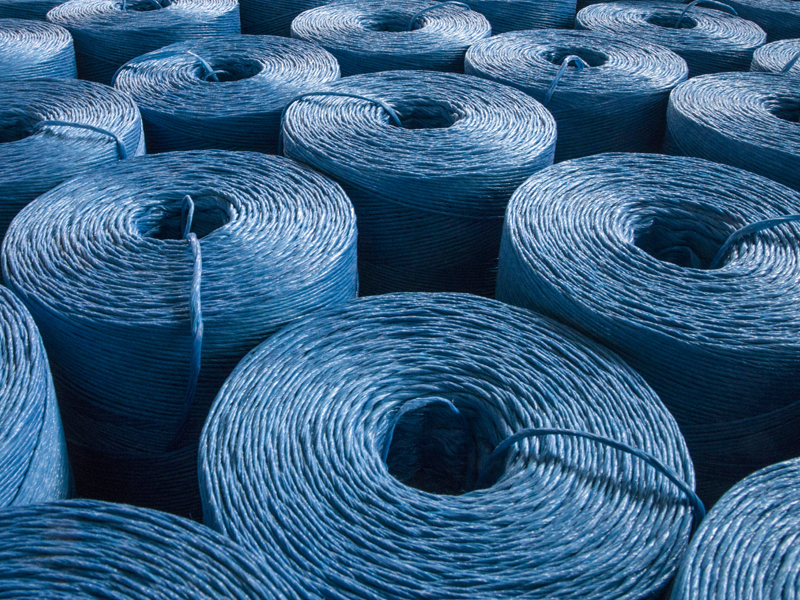
Twine with a density of 1000 tex is used for tying and packing medium and heavy loads, parcels, and furniture. Twine with a twisted structure and a density of 1000–2200 is in demand in the agro-industrial complex: for tying sheaves and bales of hay (straw). Thick and strong twine with a density of 5000 tex is used for packing large and heavy items.
There are also other product classifications:
By the weight of the skein and bobbins. Twine are wound on cylindrical or conical bobbins of precision cross winding (with or without cartridge) or coils. By weight, the bobbins are 125, 250, 500, 1000, 1500, 2000, 3000 g, and the skeins are 1000, 2000.
By the number of threads. Polypropylene threads in twine can There may be several, or maybe just one. During the manufacturing process, the threads are woven into a strong rope.
By color. Polypropylene twine can be colorless or dyed.
Product prices
Among all types of twine (both natural and synthetic), polypropylene is the cheapest. Factors affecting the cost include indicators of linear density (tex) and breaking load.
Conclusion
Possibility of use in various spheres of life, high technical and operational characteristics make it possible to classify polypropylene twine as a universal packaging material. But in order to purchase good quality products at an affordable price, you need to carefully choose a supplier.